
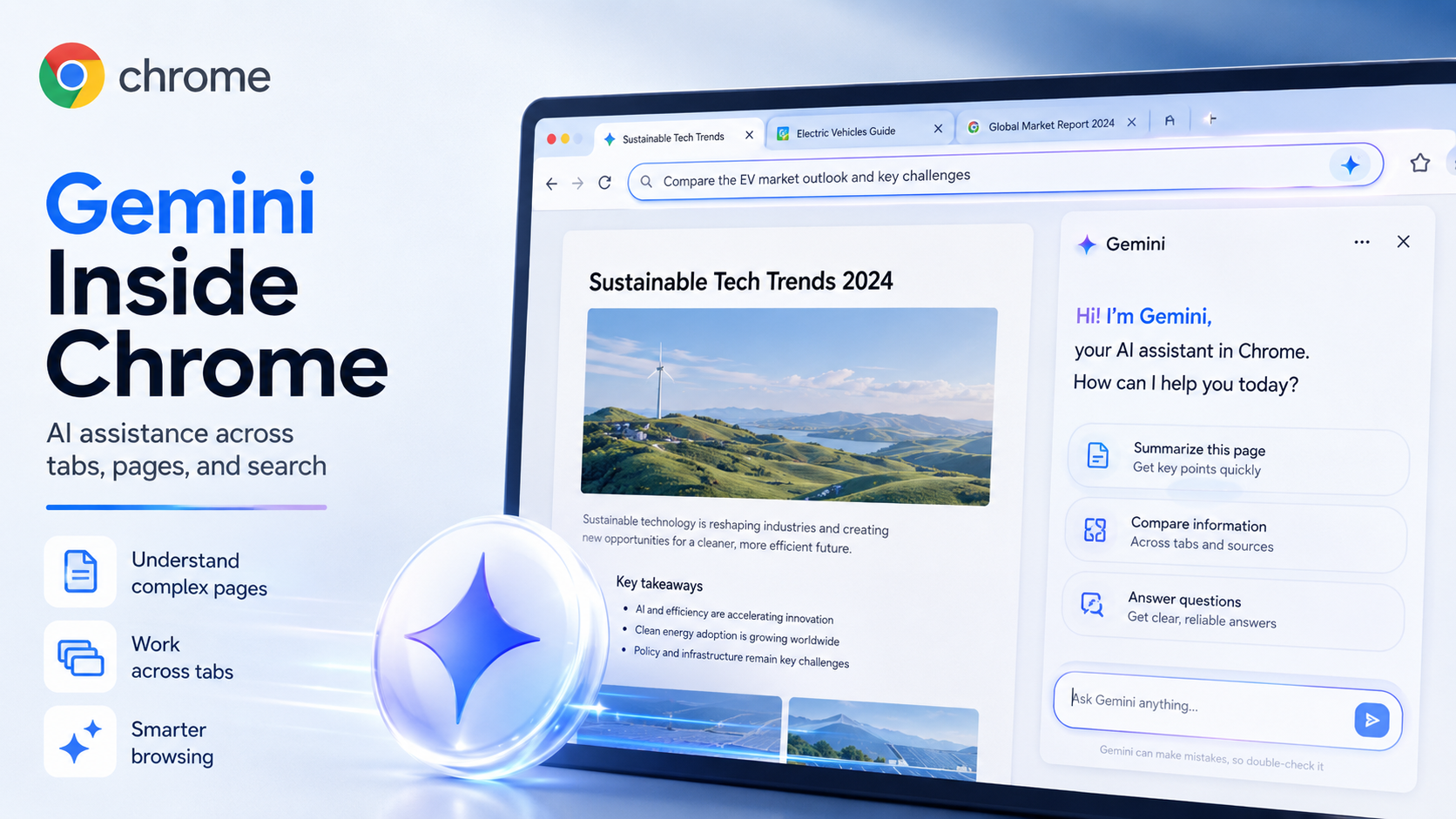
Google has described its latest AI work in Chrome as one of the browser's biggest upgrades, with Gemini becoming a central part of the browsing experience. The company says the goal is to help users understand complex information, work across tabs, search from the address bar in more powerful ways and stay safer online.
One major feature is Gemini in Chrome. Google began rolling it out to Mac and Windows desktop users in the United States whose language is set to English, allowing users to ask Gemini for help understanding the webpage or webpages they are reading. Google also said business availability would follow through Google Workspace with enterprise-grade controls and protections.
The broader vision goes beyond summarization. Google says AI in Chrome is intended to help with multi-tab work, finding previously visited pages and eventually handling more task-oriented browsing. The company has also discussed agentic browsing scenarios, where AI could help with repetitive web tasks such as making bookings or navigating complex workflows.
Chrome's address bar is also part of the AI push. Google says AI Mode in the omnibox will allow users to ask more complex questions and get AI-powered responses without treating the address bar only as a place for URLs or simple searches.
Security is another theme. Google has connected Chrome AI features to scam protection, safer browsing, notification management and password assistance. That framing is important because AI in browsers raises questions about privacy and control; Google is presenting the same technology as both a productivity tool and a protective layer.
For users, the change means Chrome is increasingly becoming an assistant-equipped browser rather than a passive window onto the web. For publishers, developers and businesses, it signals that browsing behavior may shift as users rely more on built-in AI to summarize, compare and act on web content.